An Introduction to Dialectics by Theodor W. Adorno Christoph Ziermann
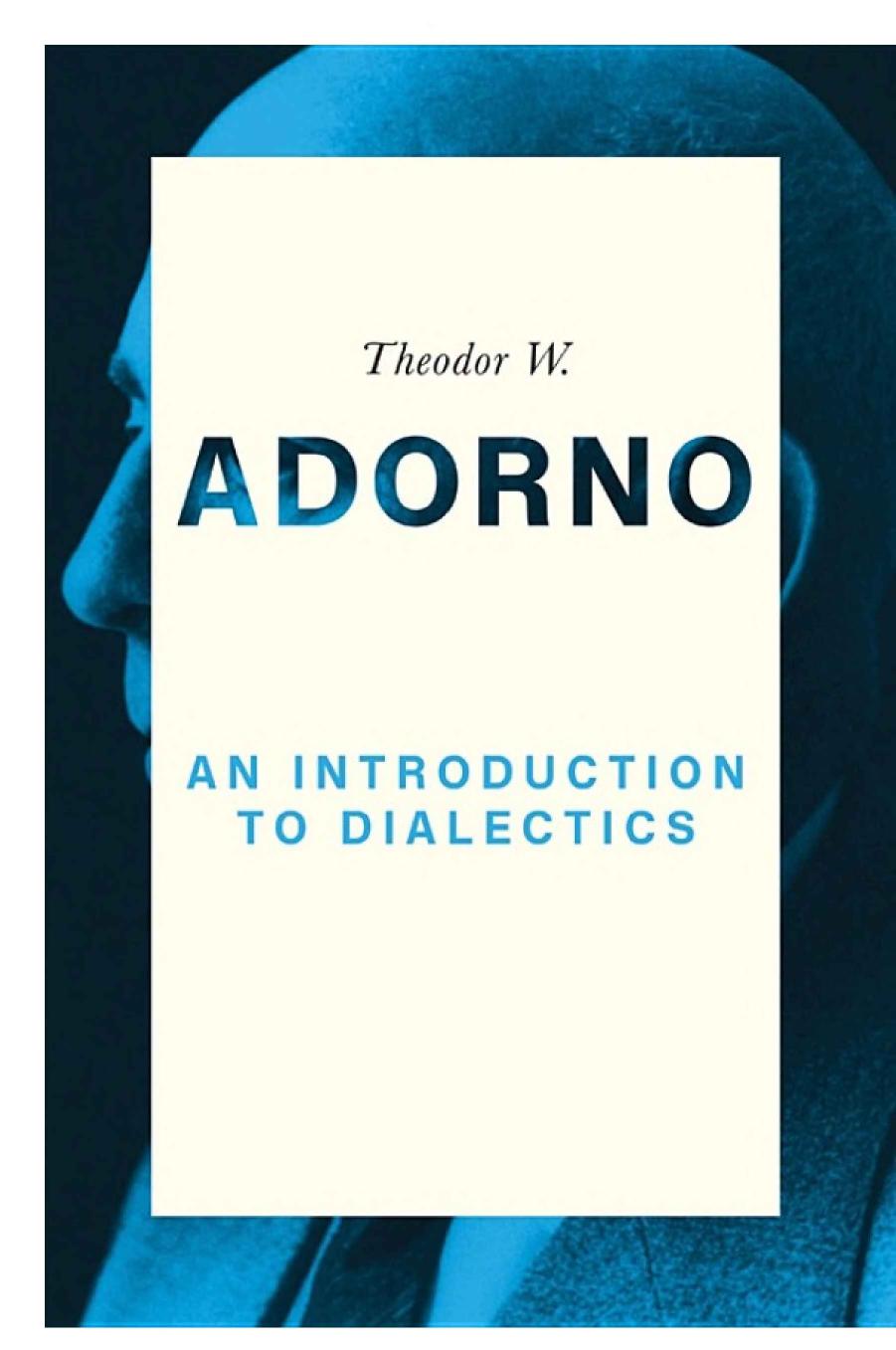
Author:Theodor W. Adorno,Christoph Ziermann
Language: eng
Format: epub, pdf
Publisher: John Wiley & Sons, Inc.
Published: 2017-03-03T05:00:00+00:00
You will know that it has become common these days to return to the standard orthography of Hegel's time and write Sein as Seyn,27 or being as ‘beyng’, and thus effectively to remove the concept from the realm of discursive thought and turn it into a magical word that is precisely meant to designate the Absolute in an immediate fashion. There is no doubt, so I am convinced, that Hegel has no other word or expression for this ‘beyng’ than precisely ‘Om, om, om’. That is to say, he would actually see here nothing but a reversion to mere mythology or an abandonment and betrayal of all that Western civilization has effectively struggled to achieve in the course of its conscious development. And any attempt to present Hegelian philosophy as genuinely compatible with such ‘Om-philosophies’ strikes me only as a sophistical attempt to cover one's own questionable manoeuvres with the authority of a thinker whose substantial concern is essentially the substance of reason, and who is here being harnessed for philosophical purposes whose substance is, rather, the renunciation of reason itself. That is all for now regarding the question of Hegel and ontology.
But here I should also like to say something about the relationship between Hegel and positivism – and this may perhaps prove the most difficult point to grasp in this context. For if my experience of the cultural and intellectual climate to which the young in particular are exposed today is not entirely mistaken, I believe that a kind of bifurcated thinking prevails, or is at least latently present, among the younger generation in this connection. Thus you may effectively say, ‘Well, of course, metaphysics, that's basically ontology, where there must be some eternal values, or an Absolute or an absolute principle of some kind, and if there is no such thing, then we are left with nothing but mere facts – that is to say, there is actually nothing but what the positive sciences ascertain in their methodical way, and anything else must be shunned as illusion.’ But it is precisely my innermost purpose in these lectures to show you the problem with this alternative: either metaphysics, on the one hand – and metaphysics amounts to a rigid doctrine of being and of invariant eternal values – or science, as an exclusive orientation to what is the case, and tertium non datur; to show you that this rigid alternative is itself the expression of the reified consciousness of today, which demands official documentation for every thought, which requires us to ask of every thought: Excuse me, but where exactly do you belong? If you are metaphysical, you must be concerned with being; if you are scientific, you must be concerned with positive facts – and that is that. But this very way of thinking in terms of set and rigidified alternatives seems to me to embody the fateful character of the contemporary state of consciousness in general. In these lectures I should like, in however modest a
Download
An Introduction to Dialectics by Theodor W. Adorno Christoph Ziermann.pdf
This site does not store any files on its server. We only index and link to content provided by other sites. Please contact the content providers to delete copyright contents if any and email us, we'll remove relevant links or contents immediately.
| Anthropology | Archaeology |
| Philosophy | Politics & Government |
| Social Sciences | Sociology |
| Women's Studies |
The remains of the day by Kazuo Ishiguro(8999)
Tools of Titans by Timothy Ferriss(8396)
Giovanni's Room by James Baldwin(7346)
The Black Swan by Nassim Nicholas Taleb(7129)
Inner Engineering: A Yogi's Guide to Joy by Sadhguru(6794)
The Way of Zen by Alan W. Watts(6614)
The Power of Now: A Guide to Spiritual Enlightenment by Eckhart Tolle(5781)
Asking the Right Questions: A Guide to Critical Thinking by M. Neil Browne & Stuart M. Keeley(5775)
The Six Wives Of Henry VIII (WOMEN IN HISTORY) by Fraser Antonia(5515)
Astrophysics for People in a Hurry by Neil DeGrasse Tyson(5189)
Housekeeping by Marilynne Robinson(4447)
12 Rules for Life by Jordan B. Peterson(4304)
Ikigai by Héctor García & Francesc Miralles(4274)
Double Down (Diary of a Wimpy Kid Book 11) by Jeff Kinney(4272)
The Ethical Slut by Janet W. Hardy(4253)
Skin in the Game by Nassim Nicholas Taleb(4248)
The Art of Happiness by The Dalai Lama(4130)
Skin in the Game: Hidden Asymmetries in Daily Life by Nassim Nicholas Taleb(4006)
Walking by Henry David Thoreau(3962)
